

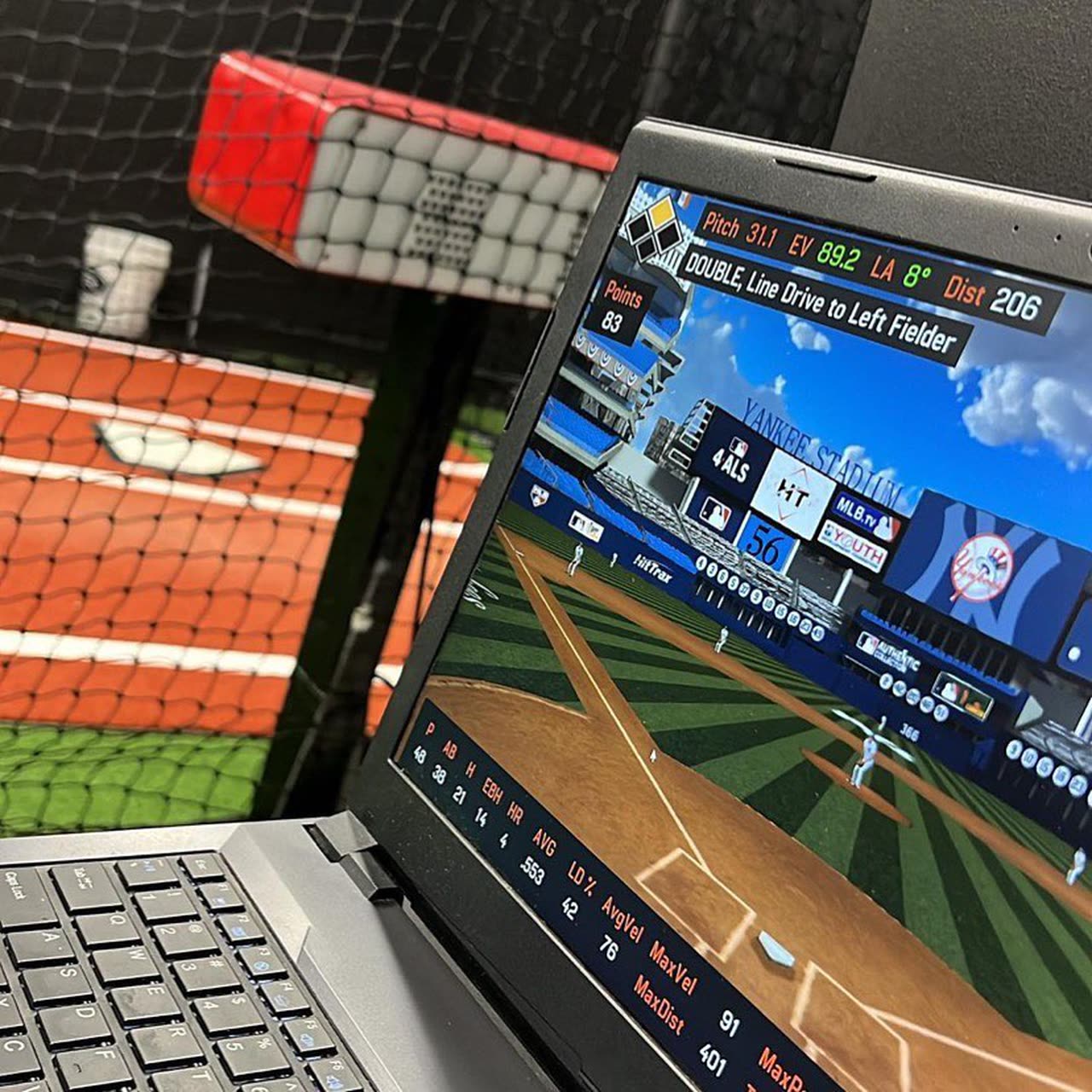
If your young hitter has ever swung on HitTrax, you’ve probably found yourself asking the question every baseball and softball parent asks: is that number good? Your player hits the ball and the screen flashes an exit velocity, but without context, it’s just a number floating in space. Is 50 mph great for an 8-year-old or nothing special? Today we’re clearing that up. At Cage Time Acworth, we track exit velocity every day, and we’ll help you understand what’s normal, what’s elite, and how to close the gap.
First, What Exactly Is Exit Velocity?
Exit velocity is simply how fast the ball leaves the bat after contact, measured in miles per hour. It’s one of the single best signs of a hitter’s power and future potential. The harder a player hits the ball, the more likely it is to sail past defenders and drop in for a hit.
Think of it as raw hitting horsepower. Two players can have identical batting averages, but the one hitting the ball harder is far more likely to keep succeeding as the competition gets tougher. Hard contact travels with a player as they grow. That’s why coaches and scouts pay so much attention to it.

A General Guide by Age
Before we list any numbers, one big reminder: these are rough guides, not report cards. Kids grow at wildly different rates, and a late bloomer can absolutely catch up. Use these ranges to understand the ballpark, not to judge your child. With that said, here’s a general sense of average exit velocity by age for youth hitters:
- Ages 7 to 9: Roughly 40 to 50 mph is common, with stronger hitters pushing higher.
- Ages 10 to 12: Many land in the 50 to 60 mph range as strength and mechanics improve.
- Ages 13 to 14: Numbers often climb into the 60 to 70 mph range as kids hit growth spurts.
- Ages 15 and up: High school hitters frequently reach 70 to 85 mph or more, with elite players going higher still.
Notice how much the numbers jump with age. A lot of that is simply the body getting bigger and stronger. Patience matters as much as practice.
What Counts as Elite?
Elite exit velocity means a player is hitting the ball noticeably harder than their peers at the same age. These are the kids whose line drives make defenders flinch. Elite numbers usually sit well above the average ranges above. For example, a 12-year-old consistently topping 65 or 70 mph is turning heads.
But here’s what parents need to hear: elite at age 10 doesn’t guarantee elite at 16, and average at 10 doesn’t mean average forever. Bodies change, and dedicated players close gaps all the time. The trend over time matters far more than any single reading. Chase progress, not a magic number.

Why You Shouldn’t Obsess Over One Number
It’s easy to fixate on exit velocity, but a single reading can be misleading. Maybe your player was tired, mistimed a pitch, or just had an off day. What really matters is the pattern across many swings and many months.
Focus on These Instead
- Is the number trending up over time? Steady growth is the real win.
- Is your player making consistent hard contact, not just one lucky bomb?
- Are they enjoying the process and staying motivated to improve?
A hitter who improves a little every month will pass a naturally gifted kid who stops working. Consistency beats raw talent over the long run.
How to Actually Increase Exit Velocity
Here’s the encouraging part: exit velocity can be trained. It’s not a fixed trait you’re stuck with. Three big things move the needle. Better mechanics, more strength, and more explosive movement.
On the mechanics side, our coaches teach players to use their legs and hips instead of just their arms, which unlocks huge amounts of hidden power. On the strength side, our brand-new weight room helps young athletes safely build the muscle that puts more force behind the bat. And our speed and agility program, led by Quincy, a former NFL athlete, develops the explosiveness that turns a good swing into a powerful one. Power comes from the whole body, not just the arms. Put those pieces together and the numbers climb.

How to Measure Exit Velocity the Right Way
If you’re going to track a number, it helps to track it fairly. A reading taken off a tee on a fresh arm tells a very different story than one taken at the end of an exhausting practice. For the truest picture, measure under consistent conditions. Here’s what we recommend:
- Warm up first. A cold hitter won’t show their real number, and swinging hard cold isn’t safe anyway.
- Use the same setup. Whether it’s off a tee, front toss, or machine, keep it consistent so you’re comparing apples to apples.
- Look at the average, not the max. One monster swing is fun, but the average of a full round tells you where your hitter really is.
- Re-test on a schedule. Checking every few weeks or once a month shows the trend without turning every session into a test.
Measured this way, exit velocity becomes a reliable friend instead of a number that bounces around and stresses everyone out. Fair measurement gives you an honest picture.
The Bottom Line for Parents
Exit velocity is a fantastic tool, but it’s a compass, not a scoreboard. Use it to guide training and celebrate progress, not to stress out your kid. Every player develops on their own timeline, and the ones who keep working almost always surprise you. That’s our whole philosophy: get 1% better every day. A few extra miles per hour this season, a few more next season, and before long your hitter is a different player entirely. Steady growth is what greatness is made of.
See Where Your Hitter Stands. Book Your Cage
Want to know your player’s exit velocity and, more importantly, how to grow it? Book Your Cage today by calling or texting (770) 779-9462, or visit cage-time.com to get your hitter on HitTrax. Our coaches will measure, explain, and build a plan to push those numbers higher. We proudly serve families across Acworth, Kennesaw, Woodstock, and all of Cobb County. Find us at 4946 Cobb Pkwy NW in Acworth, and follow along @cagetimeacworth. Greatness happens in the cage.
Ready to get 1% better?
Book a cage, a lesson, or a membership at Cage Time Acworth.
Book Your Cage